

U Kx Yx For X
First Order Linear Differential Equations
You might like to read well-nigh Differential Equations
and Separation of Variables outset!
A Differential Equation is an equation with a function and ane or more of its derivatives:
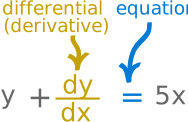
Example: an equation with the function y and its derivative dy dx
Here nosotros volition await at solving a special class of Differential Equations chosen First Lodge Linear Differential Equations
First Order
They are "Start Order" when there is only dy dx , not diiy dxii or diiiy dx3 etc
Linear
A showtime order differential equation is linear when it can exist fabricated to look like this:
dy dx + P(ten)y = Q(10)
Where P(x) and Q(x) are functions of ten.
To solve information technology there is a special method:
- We invent two new functions of x, call them u and v, and say that y=uv.
- We and then solve to find u, and so detect v, and tidy upwards and nosotros are done!
And nosotros too use the derivative of y=uv (see Derivative Rules (Product Rule) ):
dy dx = u dv dx + v du dx
Steps
Here is a step-by-pace method for solving them:
- ane. Substitute y = uv, and
dy dx = u dv dx + 5 du dx
intody dx + P(x)y = Q(x)
- 2. Factor the parts involving v
- 3. Put the v term equal to zero (this gives a differential equation in u and x which tin can exist solved in the next step)
- 4. Solve using separation of variables to notice u
- 5. Substitute u back into the equation we got at step 2
- half-dozen. Solve that to find 5
- vii. Finally, substitute u and 5 into y = uv to get our solution!
Let'due south try an instance to see:
Example 1: Solve this:
dy dx − y x = one
First, is this linear? Aye, every bit it is in the form
dy dx + P(ten)y = Q(x)
where P(x) = − 1 x and Q(x) = one
So let's follow the steps:
Step 1: Substitute y = uv, and dy dx = u dv dx + five du dx
So this: dy dx − y ten = 1
Becomes this: u dv dx + five du dx − uv ten = 1
Footstep ii: Factor the parts involving v
Factor five: u dv dx + v( du dx − u x ) = 1
Step three: Put the 5 term equal to zero
v term equal to nix: du dx − u x = 0
So: du dx = u x
Step 4: Solve using separation of variables to find u
Separate variables: du u = dx x
Put integral sign: ∫ du u = ∫ dx 10
Integrate: ln(u) = ln(ten) + C
Make C = ln(g): ln(u) = ln(x) + ln(k)
And so: u = kx
Stride 5: Substitute u dorsum into the equation at Pace 2
(Think v term equals 0 and so can be ignored): kx dv dx = i
Step 6: Solve this to find v
Separate variables: thousand dv = dx x
Put integral sign: ∫k dv = ∫ dx x
Integrate: kv = ln(x) + C
Make C = ln(c): kv = ln(x) + ln(c)
And then: kv = ln(cx)
And so: v = ane k ln(cx)
Step 7: Substitute into y = uv to find the solution to the original equation.
y = uv: y = kx 1 k ln(cx)
Simplify: y = x ln(cx)
And it produces this overnice family unit of curves:
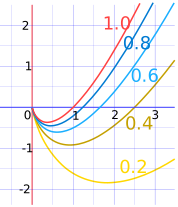
y = x ln(cx) for various values of c
What is the meaning of those curves?
They are the solution to the equation dy dx − y x = 1
In other words:
Anywhere on whatever of those curves
the slope minus y 10 equals 1
Let's check a few points on the c=0.6 curve:
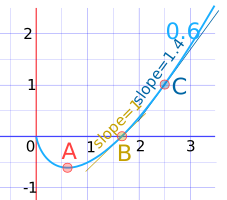
Estmating off the graph (to one decimal place):
| Point | 10 | y | Slope ( dy dx ) | dy dx − y x |
|---|---|---|---|---|
| A | 0.6 | −0.6 | 0 | 0 − −0.6 0.half-dozen = 0 + 1 = 1 |
| B | ane.six | 0 | 1 | 1 − 0 1.vi = i − 0 = 1 |
| C | 2.5 | 1 | one.4 | 1.four − 1 2.5 = 1.4 − 0.4 = 1 |
Why not exam a few points yourself? You tin can plot the curve here.
Perchance another example to help you? Maybe a picayune harder?
Instance 2: Solve this:
dy dx − 3y ten = ten
First, is this linear? Yes, as it is in the form
dy dx + P(x)y = Q(x)
where P(x) = − 3 10 and Q(x) = 10
And then let's follow the steps:
Step 1: Substitute y = uv, and dy dx = u dv dx + 5 du dx
So this: dy dx − 3y 10 = x
Becomes this: u dv dx + v du dx − 3uv x = ten
Pace 2: Factor the parts involving v
Factor v: u dv dx + v( du dx − 3u 10 ) = ten
Footstep 3: Put the v term equal to nix
five term = zero: du dx − 3u ten = 0
So: du dx = 3u x
Step iv: Solve using separation of variables to notice u
Divide variables: du u = 3 dx x
Put integral sign: ∫ du u = three ∫ dx ten
Integrate: ln(u) = 3 ln(x) + C
Make C = −ln(thousand): ln(u) + ln(k) = 3ln(ten)
Then: u.k. = teniii
And so: u = x3 k
Step 5: Substitute u back into the equation at Step 2
(Recollect five term equals 0 then can be ignored): ( xthree k ) dv dx = x
Footstep 6: Solve this to discover 5
Carve up variables: dv = grand x-ii dx
Put integral sign: ∫dv = ∫k x-2 dx
Integrate: v = −one thousand x-one + D
Step 7: Substitute into y = uv to find the solution to the original equation.
y = uv: y = x3 k ( −m ten-1 + D )
Simplify: y = −102 + D k ten3
Replace D/k with a single constant c: y = c x3 − x2
And it produces this squeamish family of curves:
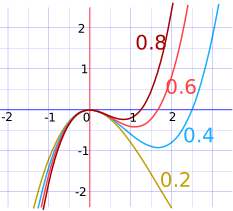
y = c x3 − 102 for various values of c
And 1 more example, this time even harder:
Case 3: Solve this:
dy dx + 2xy= −2x3
First, is this linear? Yes, as it is in the form
dy dx + P(x)y = Q(x)
where P(ten) = 2x and Q(x) = −2xiii
So let'south follow the steps:
Step 1: Substitute y = uv, and dy dx = u dv dx + v du dx
And so this: dy dx + 2xy= −2x3
Becomes this: u dv dx + v du dx + 2xuv = −2x3
Step two: Factor the parts involving v
Factor v: u dv dx + five( du dx + 2xu ) = −2x3
Step iii: Put the five term equal to zero
v term = zero: du dx + 2xu = 0
Stride iv: Solve using separation of variables to find u
Separate variables: du u = −2x dx
Put integral sign: ∫ du u = −2∫x dx
Integrate: ln(u) = −xii + C
Make C = −ln(k): ln(u) + ln(thousand) = −x2
Then: united kingdom of great britain and northern ireland = eastward-102
And then: u = e-xii k
Step 5: Substitute u back into the equation at Step ii
(Remember v term equals 0 so can be ignored): ( eastward-ten2 k ) dv dx = −2xiii
Step 6: Solve this to notice v
Separate variables: dv = −2k 10three eastwardx2 dx
Put integral sign: ∫dv = ∫−2k xthree ex2 dx
Integrate: v = oh no! this is hard!
Let's see ... we can integrate past parts... which says:
∫RS dx = R∫Southward dx − ∫R' ( ∫South dx ) dx
(Side Note: we use R and South here, using u and v could be confusing as they already hateful something else.)
Choosing R and S is very important, this is the best option nosotros institute:
- R = −ten2 and
- S = 2x e102
So permit'due south go:
First pull out k: five = k∫−2x3 eastxtwo dx
R = −102 and S = 2x east102 : v = k∫(−xtwo)(2xe102 ) dx
Now integrate by parts: v = kR∫Southward dx − yard∫R' ( ∫ S dx) dx
Put in R = −102 and S = 2x eastxtwo And likewise R' = −2x and ∫ S dx = eastwardx2
Then information technology becomes: five = −kxii ∫2x ex2 dx − yard∫−2x (eastten2 ) dx
Now Integrate: v = −kx2 eastwardten2 + k eastx2 + D
Simplify: v = kex2 (i−102) + D
Step 7: Substitute into y = uv to find the solution to the original equation.
y = uv: y = e-x2 grand ( kexii (1−10two) + D )
Simplify: y =1 − 102 + ( D m )e- xtwo
Supervene upon D/k with a single constant c: y = i − tentwo + c east- 102
And we get this nice family of curves:
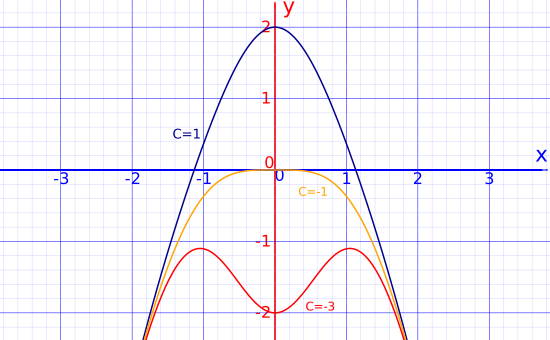
y = 1 − ten2 + c east- tentwo for various values of c
9429, 9430, 9431, 9432, 9433, 9434, 9435, 9436, 9437, 9438

U Kx Yx For X,
Source: https://www.mathsisfun.com/calculus/differential-equations-first-order-linear.html
Posted by: howardwalathever68.blogspot.com
0 Response to "U Kx Yx For X"
Post a Comment