

How Many Degrees It Is
- Introduction
- Factors Affecting Institute Growth
- Light
- Temperature
- Relative Humidity
- Water
- Nutrition
- Soil/Growing Medium
- What to Look for When Shopping for Indoor Plants
- Selecting Containers
- Pruning, Preparation, Cleaning and Repotting
- Pest Management
- What to Do for Plant Issues
- Summary of Cultural Care
- Bibliography
Introduction
Much of the scenic beauty of nature has been replaced by densely populated areas that sprawl for miles from urban centers. This visual pollution affects us all and leaves u.s. with a longing for a closer connexion with nature. Nosotros spend about 90 percentage of our fourth dimension indoors. Interior plants are an ideal fashion to create attractive and restful settings while enhancing our sense of well being. In addition, houseplants can be a satisfying hobby and tin help purify the air in our homes. Indoor plants not only convert carbon dioxide to oxygen, but they also trap and absorb many pollutants. Many of these chemical compounds, which are released into our air through a process called "off-gassing," come from everyday items present in our homes and offices.
To be a successful indoor gardener, you need to sympathise how the interior environment affects plant growth and how cultivation differs from growing plants outdoors.
Factors Affecting Constitute Growth
Plant growth is afflicted by light, temperature, humidity, water, nutrition, and soil.
Calorie-free
Of all of the factors affecting constitute growth in interiors, adequate low-cal is past far the near of import. Light is needed for plants to produce food and survive — more often than not, the more light available, the more nutrient produced for growth. Light is measured in units called foot candles. One footcandle (ft-c) is the corporeality of light cast by a candle on a white surface i foot away in a completely dark room. Outdoors, the light levels on a bright solar day range from 10,000 ft-c in an open sunny area to 250 ft-c or less in the shade of a large tree.
Information technology is very helpful to have a general idea of how much light is present in a given location in your house. You can become a fairly skilful approximate with a handheld light meter, or you tin can use a 35 mm camera and do the following:
- Set the moving-picture show speed indicator to ASA 25 and the shutter speed to ane/60th second.
- Identify a piece of white paper where you desire to measure the lite levels, aim the camera toward the paper close enough to fill the view, and accommodate the f/stop so that the meter indicates a correct exposure.
- Read the approximate light level from Table ane.
| Table 1. Indoor light levels and appropriate f/end settings | |
| f/terminate Setting | Light Level |
| f/2 | 40 ft-c |
| f/2 | 75 ft-c |
| f/4 | 150 ft-c |
| f/5.6 | 300 ft-c |
| f/8 | 600 ft-c |
| f/11 | one,200 ft-c |
| f/sixteen | 2,400 ft-c |
With the help of this table, you tin can obtain the light intensity reading from anywhere in your home. For example, if the f/finish setting is f/16, the approximate low-cal level is 2,400 ft-c.
Using the light readings, your home can exist divided into four areas, which have the post-obit light levels for viii hours per twenty-four hours:
- Low-light areas: 25 ft-c – 75 ft-c
- Medium-light areas: 75 ft-c – 200 ft-c
- High-lite areas: over 200 ft-c but not straight sunlight
- Sunny light areas: at to the lowest degree 4 hours of direct sunlight
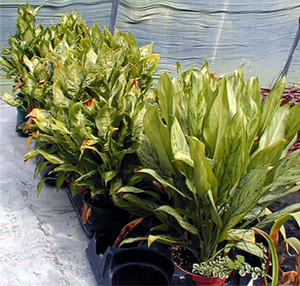 Figure 1. Many foliage plants are native to tropical rain forests, where lite levels are low. These plants tin can be easily injured if exposed to strong light. Symptoms of over-exposure are upright leaves and bleached, scorched leaves. Do not place loftier-lite sensitive plants in direct sunlight (on a porch or in front end of a window). In this example, Chinese Evergreen (Aglaonema) and Dumb Cane (Dieffenbachia) testify symptoms of high-lite harm.
In your home, the corporeality of light in a given location is variable — information technology is affected by the presence of copse outdoors (may shade at certain times), roof overhangs (may shade at certain times), wall color (reflectance), window curtains, 24-hour interval length, time of day, and fourth dimension of year.
When shopping for indoor plants, select plants for a given location based on the approximate light levels in the spot. The institute's characterization will usually contain data on the lite requirements of the establish. If the plant label lists "high calorie-free" but the selected area in the home does non provide adequate low-cal, artificial low-cal sources such equally fluorescent and/or special incandescent lights may be used to supplement the natural calorie-free.
Increasing the number of hours of light exposure tin also help—for example, sixteen hours of light and 8 hours of dark. This extends the number of hours during which plants receive light.
While adequate low-cal is crucial for plant growth, too much light can be damaging (Figure i).
Indoor plants are classified according to the amount of light needed for growth. (A list of plants and their light requirements is provided in Table 3.) Wait for this information in full general terms on the plant'southward label:
- Low: minimum 25 ft-c – 75 ft-c, 75ft-c – 200 ft-c for skilful growth
- Medium: minimum 75 ft-c – 150 ft-c, 200 ft-c – 500 ft-c preferred
- Loftier: minimum 150 ft-c – ane,000 ft-c, 500 ft-c – one,000 ft-c preferred
- Very high: minimum one,000 ft-c, 1,000+ ft-c preferred
Windows with eastern exposure within the home mostly provide the all-time light and temperature weather for most indoor institute growth considering plants receive direct morning low-cal from sunrise until nearly midday. Footcandle readings at these windows tin can achieve v,000-8,000. Every bit the forenoon progresses, the straight sun recedes from the room.
An eastern room is cooler than southern or western rooms because the house absorbs less radiant heat. Calorie-free from the east is cooler than that from the south or the west, and thus it causes less h2o loss from the plants.
Windows with southern exposure give the largest variation of calorie-free and temperature weather condition. The low wintertime sunday shines across the room for nigh of the daylight hours.
In the summer, when the sun is farther north than information technology is in the winter, the sunday rises at a sharp angle in the morning and is high in the sky by noon. Direct light comes into a south window only at midday. If there is a wide overhang roofing the windows exterior, the sunday may non enter the room at all. The sun at noon on a summer day may measure 10,000 ft-c. Indoors, even so, a southern window with broad eaves on the outside will receive about the aforementioned amount of low-cal as a window with northern exposure. Southern and western exposures are interchangeable for most plants. In the winter, most plants, except those with definite preference for northern exposure, can exist placed in a room with southern exposure.
Windows with northern exposure provide the least low-cal and the lowest temperature. Because the United States is in the northern hemisphere, it receives most of its sunlight from the south. Out of the four exposures, the northern exposure receives the to the lowest degree calorie-free and rut year round.
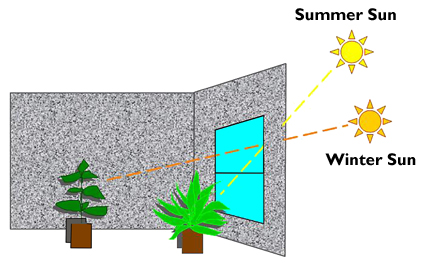 Figure 2. Within your domicile, changes in natural light penetration occur with the seasons.
Because of the low-light levels, maintaining good for you plants can be a challenge. A northern windowsill can measure light levels as low as 200 ft-c on a clear winter solar day, which is optimal for some plants, such as the African violet. This exposure is best for plants with dark-green foliage because the coloration on variegated foliage tends to disappear under depression-low-cal conditions. Although most plants grown indoors will non abound in a northern room, they may tolerate it for brusque periods of fourth dimension.
Seasons change the amount of natural light inbound through windows. For instance, the summer lord's day reaches a higher zenith compared to the winter sunday (Figure ii). Therefore, sunlight penetrates further into a room during winter.
How tin y'all tell if your plant is not receiving acceptable light?
- The plant does not grow.
- The internodes (spaces between the leaves) on the new growth are much longer than the internodes on the older part of the plant.
- The new leaves are smaller than the older leaves.
- The leaf color is a lighter greenish on the newer foliage than on the older leaf.
- The older leaves are dead.
Temperature
Temperature is the 2nd nigh of import gene influencing plant growth in interior environments. People feel comfortable in the range of 72 degrees F-82 degrees F, and interior plants tin can tolerate and abound well in the 58 degrees F-86 degrees F range considering most indoor plants originate from tropical and subtropical areas of the world.
Temperature and light are linked through the processes of photosynthesis and respiration. These processes can be idea of as the "yin and yang" of plant life — two parts of a circle. Photosynthesis builds sugars and starch, which are then broken downward by respiration to provide energy for the development of new tissues (growth) and the maintenance of existing ones. High temperature speeds upward respiration. If the plant is not producing sufficient sugars (equally under low light), then high temperatures may suspension down what piffling sugars are made, leaving little to none for growth. Maintenance takes precedence over growth; therefore, under insufficient low-cal, plants do not abound. If lite is then low that sugars produced are bereft for maintenance, the institute somewhen dies.
When sugar levels are low, the found takes nutrients and sugars from older leaves to maintain new leaves. To aid plants in an indoor surroundings, two options are available: (1) raise lite levels to increment photosynthesis and carbohydrate production or (2) reduce night temperature to lower respiration rates and allow more sugars for growth.
What temperatures are likely to occur in homes? During the summer, air-conditioning that may take been turned off at dark or weekend thermostat settings that may have been raised result in higher than desirable night temperatures. During the wintertime, heating that may have been turned off at night or weekend thermostat settings that may have been lowered may result in lower night temperatures. Be especially careful not to allow temperatures to drop beneath 50 degrees F, or chill harm volition outcome on some sensitive leafage plants (due east.chiliad., Chinese Evergreen, Aglaonema). Arctic damage is manifested with the yellowing of lower leaves and/or defoliation.
Plants vary in their minimum and maximum temperature requirements. Examples of cool-loving plants suitable for locations where temperatures drop to the low 50s at night and 60s during the day are Cyclamen, Wonder Plant, Fatshedera, Japanese Aralia, and Fatsia. A list of plants and their temperature requirements is provided in Table iii.
Non all interior plants have the same temperature requirements for optimal growth. For example, Bandage Iron Plant, Aspidistra, and ferns actually grow better with libation temperatures (72°F), while other tropical plants grow best if the temperatures are 90 degrees F – 95 degrees F. Such temperatures are rarely allowed indoors.
The all-time temperature range for indoor plants is 70 degrees F – 80 degrees F twenty-four hour period and 65 degrees F – 70 degrees F night.
Relative Humidity
Relative humidity is the corporeality of moisture contained in the air. For interior plants, relative humidity beneath 20 percent is considered low, 40 pct – fifty percentage is medium, and to a higher place 50 pct is high. Relative humidity is a very important factor, simply information technology is easily overlooked. In a greenhouse, relative humidity is l percent or higher. Rapid transpiration and h2o loss may issue when newly purchased plants are placed in the 10 per centum – 20 percent relative humidity typical of most homes (Effigy iii). Most indoor plants come up from the tropics where high relative humidity is common. Therefore, take the post-obit steps to assistance your plants arrange to the low relative humidity in your dwelling house.
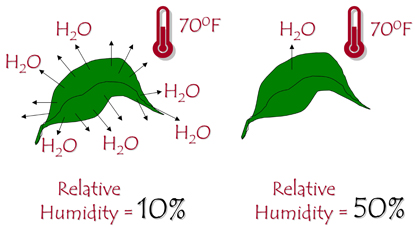 Figure 3a. The lower the humidity, the more h2o is lost from a leaf. At the same temperature of 70ºF, a leaf placed in ten% relative humidity loses more water compared with the leaf placed in 50% relative humidity.
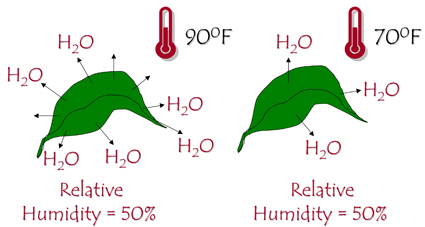 Figure 3b. The higher the temperature, the more water vapor the air can agree, and the more than water volition be lost from the plant. At the same humidity of fifty%, a leaf placed in 90ºF air loses more water compared with the leaf placed in 70ºF air.
- Place plants close together to create a microenvironment with a higher relative humidity.
- Utilize a shallow container filled with water and lava rocks or gravel, which will provide evaporation from a large surface area and increment relative humidity.
- Utilize a humidifier.
- Use mist bottles to spray h2o around the establish; however, in reality, yous would demand to mist every few minutes for an indefinite amount of fourth dimension to make a deviation in relative humidity around the plant.
- The leaf and flowers of plants with hairy leaves should not be sprayed with water. Water on such leaves may stay longer, providing opportunities for disease spores to germinate.
Water
Water Quantity
Learning to water is 1 of the most important skills in plant intendance. Applying too much water can suffocate plant roots and likewise little water causes growth to become erratic and stunted. Watering frequency will depend on the weather condition under which the plants are growing. When dealing with how much water to apply, consider the following:
- Plant type: A list of plants and their wet requirements is provided in Tabular array 3. Non all plants are similar in their water requirements. This data, along with the low-cal preference, is usually included on the plant label. For example, a croton, which prefers high light, will probable need more than frequent watering compared with a succulent plant such as Opuntia cactus. Both take similar light needs only unlike water requirements.
- Plant size: Larger plants need more water compared to smaller plants.
- Container volume: If the growing container is too small, watering may be required more than oftentimes.
- Soil moisture: The corporeality of water already nowadays in the growing medium will also affect your watering frequency.
- Calorie-free intensity: Plants under high low-cal transpire more than water compared with plants under low light.
Improper watering causes many problems. Containers with saucers may cause an excessive build-upwards of soluble salts (from the applied fertilizer). High levels of soluble salts can cause harm to plant roots and a decline in growth. Discard any water that had tuckered in the saucer after irrigation, and apply large quantities of water to the soil to leach the accumulated soluble salts. In deciding when you should water, feel the soil by pushing a finger an inch or and then beneath the surface. If the soil is still moist, no further water is needed. Water devices or water meters are also available to simplify watering.
Water Quality
The quality of the irrigation water is an issue with plants that are susceptible to fluorine and chlorine, such every bit Corn Institute (Dracaena), Ti Plant (Cordyline), Peacock Institute (Maranta), and Rattlesnake Plant (Calathea) (Figure four). Alleviate this trouble past letting the water stand for several days — then that some chlorine and fluorine will be released from it — earlier applying the water to the plants. Movement susceptible plants abroad from the edge of the puddle to forbid h2o splashes from reaching the foliage. Do not utilize susceptible plants around enclosed pools. In general, plants with long linear leaves (such as the Spider Constitute) are more than susceptible to fluorine.
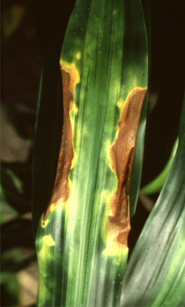 Figure 4a. Symptoms of fluorine harm on the Corn Constitute include tip and leaf scorching.
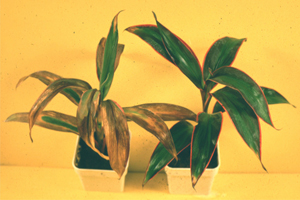 Figure 4b. Symptoms of fluorine damage on the Ti Constitute include tip and foliage scorching.
Nutrition
Many indoor gardeners take the same problem with fertilizer that they accept with water — they want to requite their plants too much. Danger from over-fertilization occurs considering any fertilizer used, whether in liquid, powder, or tablet form, will dissolve in soil water and will grade salts in the water. When you over-fertilize, the h2o in the soil becomes so salty that it "burns" the constitute'southward roots by removing h2o from them (Effigy 5). Excess soluble salts accrue every bit a whitish crust on the surface of the growing medium and/or near the rim of the container.
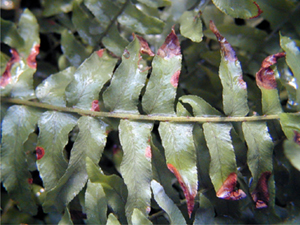 Figure 5a. Soluble common salt burn down is manifested as leafage martinal and tip burn. Expressionless roots also invite root diseases.
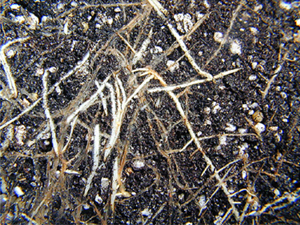 Figure 5b. Soluble salts tin can fire roots; observe that the healthy roots are white, while the expressionless roots are brown. Expressionless roots also invite root diseases.
Earlier feeding plants, consider the following:
Institute type: Some plants are heavy feeders (due east.grand., Ficus species), while others need little or no boosted fertilizer for months (e.chiliad., succulents).
Volume of soil: The growing medium that is nowadays — smaller pots require less fertilizer compared with larger pots because they contain less soil.
Light intensity: The higher the light levels, the more nutrients needed for institute growth.
A newly purchased, healthy plant rarely needs an immediate application of fertilizer. In nearly cases, the amount of fertilizer practical past the commercial producer will supply plenty nutrients for two to three months in the dwelling house. This rule is flexible — if deficiency symptoms are evident, fertilizer awarding is desirable.
The secret to fertilizing plants indoors is to utilize small amounts of fertilizer as the plant grows. Without new growth, the found has a limited need for more than fertilizer. During the winter when calorie-free levels are depression, a plant's need for fertilizer reduces. During the summer when light levels increase and the plant is actively growing, its need for fertilizer increases. Every bit a starting point, use about 1-quaternary the characterization rate for monthly applications. If the overall plant color becomes lighter green, fertilize every two weeks. If the new growth is dark light-green merely the leaves are minor and internodes seem longer than on the older growth, decrease the fertilizer rate.
Varying fertilizer formulations are bachelor to the indoor gardener. Many fertilizers come in specially designed formulas for indoor plants. Generally, they comprise a lower percentage of the required mineral elements to prevent over-fertilization problems.
Soil/Growing Medium
The growing medium provides anchorage, water, and minerals. When repotting plants, make sure that the new mix is well drained and aerated, holds h2o and nutrients well, and is inside the right pH range (5.0-half dozen.5). A good potting mix provides ample amounts of oxygen to the root organisation. Most professional mixes are adept to use. Some plants crave special mixes, east.chiliad., bromeliads, orchids, and African violets. Either purchase these mixes or prepare your own. Beneath are some formulas that can be used to prepare a homemade potting mix.
Growing Mix for Flowering House Plants
The following potting mix will grow acceptable flowering plants in most homes for nearly gardeners:
- 1 part garden loam or potting soil
- 1 part sand or perlite or vermiculite
- i part peat moss
Add 2 to 3 ounces of 20 pct superphosphate and ¾ ounce of either bonemeal or dolomitic limestone (by weight) to 4 gallons of potting mix. Afterward sterilizing the soil (see "How to Sterilize Soil"), add 3 tablespoons of a 6-6-6 or similarly balanced fertilizer to every 4 gallons (½ bushel) of mix. Add together a small-scale chemical element formulation co-ordinate to the manufacturer'due south recommendations.
Growing Mixes for Foliage Plants
Although nearly foliage plants will abound satisfactorily in the growing mix recommended for flowering house plants, they will grow better if the mix contains a college percentage of organic matter.
- 1 role garden loam or potting soil
- 1 part sand or 2 parts peat moss
OR
- 1 office pine bark
- ii parts peatmoss
OR
- 1 part sand
- 1 part pine bark
- 1 part peat moss
Add 2 to 3 ounces (dry weight) of dolomitic limestone to 4 gallons (½ bushel) of mix. For fluoride-sensitive plants, adjust the pH so it is no lower than pH 6.5. Superphosphate contains enough fluoride to crusade foliar burn down on sensitive plants. Afterwards sterilizing the soil, add iii tablespoons of a 6-6-6 or another fertilizer such as 5-10-v to each ½ bushel. Plastic-coated fertilizers also can be used; most of them require about 2 ounces per ½ bushel. Add a minor element formulation to the potting mix per the manufacturer's recommendation.
Growing Mixes for Bromeliads
Bromeliads are plants from Central and South America, which are either epiphytic (they abound on tree branches or in the crotches of trees) or terrestrial (they grow in the ground). Although most of the bromeliads can be grown successfully in foliage institute mixes, most abound better in specially designed soil mixes. Any mix for bromeliads must be well aerated and drained.
- 2 parts peat moss
- 1 part perlite
- 1 part fir bark
OR
- one part peat
- 1 part pine bark
OR
- 1 part peat
- 1 part pine bark
- one part cypress shavings
Add 2 ounces of dolomitic limestone to iv gallons (½ bushel) of soil mix and a small-scale chemical element mix. Deliquesce 1 ounce of 10-10-10 water-soluble fertilizer in iii gallons of h2o. Use this solution subsequently repotting and over again monthly when watering. Besides, add enough h2o to fill the vase formed by the overlapping foliage bases.
Growing Mixes for Orchids
Orchids have a great bargain in common with bromeliads because they likewise grow on copse as epiphytes and on the ground equally terrestrials. A mix for orchids should accept first-class drainage and aeration, too. Some soil mixes that can exist used are:
- 3 parts osmunda tree fern cobweb (moisten before use by soaking in h2o for 12 hours)
- 1 part redwood bark
OR
- 5 parts fir bark
- 1 office perlite
Tree fern slabs may also be used to abound epiphytic orchids.Add ane ounce (dry weight) of dolomitic limestone per four gallons (½ bushel) of soil mix. Do not add together fertilizer to the mix. After the plants are potted, add ¼ ounce of liquid 10-10-ten with minor elements per gallon of h2o and fertilize once every 6 weeks (if the plants are growing in osmunda fern fibers). If plants are growing in fir bark, use a liquid 30-x-10 with minor elements every 6 weeks instead of a 10-10-10 fertilizer.
Growing Mix for Succulents and Cacti
Cacti and other succulents grow all-time in a well-drained and aerated soil.
- 2 parts garden loam or potting soil
- two parts sand
- ii parts peat
- i part perlite (crushed charcoal tin can be substituted)
Add 2 ounces (dry weight) of dolomitic limestone to 4 gallons (½ bushel) of soil mix, 2 ounces (by weight) of bonemeal, and ½ ounce of superphosphate. After sterilizing the soil, add a minor element supplement according to the manufacturer'due south recommendation.
Growing Mix for Ferns
Ferns abound well in about recommended mixes that accept a high proportion of organic matter with good soil aeration and drainage characteristics. Use any of the suggested leaf plant mixes. However, almost ferns kept indoors grow ameliorate in the following mix:
- 1 part garden loam or potting soil
- 1 part peat moss
- 1 part pine bark
- 1 part coarse sand
Add 2 ounces (dry out weight) of dolomitic limestone to each ½ bushel (four gallons) of soil mix and ½ ounce of either bonemeal or 20 percent superphosphate. Subsequently pasteurizing the soil mix, add together minor elements to the mix. Add i tablespoon of a 6-vi-6 or similarly balanced fertilizer to each ½ bushel of soil mix.
Growing Mix for African Violets
Any number of soil mixes for African violets exist, and most of them will grow loftier quality plants. A good mix should be well drained and aerated.
- 2 parts peat moss
- ane part vermiculite
- 1 role perlite
Add ii½ tablespoons of dolomite and 1½ tablespoons of xx per centum superphosphate to each ½ bushel of soil mix. Add together iii tablespoons of a loftier phosphorous fertilizer such as 5-10-5 or a like ratio of fertilizer.
How to Sterilize Soil
Sterilization reduces the number of diseased organisms and weeds nowadays in the soil. First, mix the soil with an equal portion of vermiculite or peat moss (otherwise, the soil volition become very difficult). Next, moisten the mixture and place it in the oven. Permit it to "broil" at 180 degrees F–200 degrees F for 1 hour. One time the soil cools, it is ready to use. To treat soil in the microwave, first mix the portion with an equal amount of vermiculite or peat moss and moisten. Identify the mixture in a plastic bag. Side by side, consult the manufacturer's manual to make up one's mind the amount of fourth dimension and power level needed to estrus the quantity of soil to about 180 degrees F (most portions of soil will generally require nigh ten to xv minutes). Insert a probe into the soil and make sure information technology has heated to 180 degrees F – 200 degrees F. Allow the soil to cool earlier using it or storing it for future use.
Make sure that the soil or potting mix y'all want to sterilize does not contain perlite. At high temperatures, toxic levels of fluoride may exist released and subsequently harm your plants.
Acclimatization
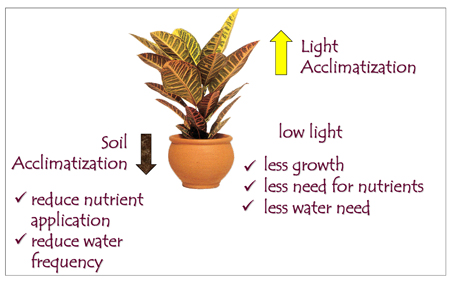 Figure 6. The two sides of acclimatization — the above-footing (light acclimatization) involves adaptation to low calorie-free, which ways less growth and less need for nutrients. The below-basis (soil acclimatization) involves reduction of nutrients and water.
Acclimatization is the adaptation of a plant to a new environs, and it is very important for the wellness and growth of indoor plants. In greenhouses, plants are accustomed to loftier light, nutrition, h2o supply, temperatures, and relative humidity — weather condition ideal for fast growth (Effigy 6). Residential homes, with low-low-cal interiors and low relative humidity, will most likely produce a stressful experience for plants — the greater the difference between the previous surround and the environs of the house, the greater the stress the plant endures.
Acclimatization is generally washed in the greenhouse or the nursery. Plants are grown for a period of fourth dimension under low-light levels and with fewer nutrients. Because this slows downwardly plant growth, acclimatized plants are not ready for the market as early as nonacclimatized plants. Acclimatized plants cost more compared to nonacclimatized plants, merely this is coin well spent. Figure vii and Table 2 draw the symptoms and advent of acclimatized plants.
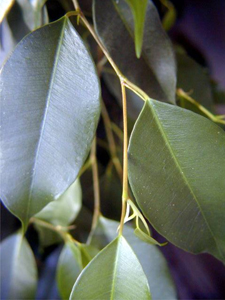 Figure vii. Acclimatized Weeping Fig; detect the large, dark light-green leaves and the elongated internodes.
To acclimatize plants at home, place newly purchased plants in bright areas for at least iii to 4 weeks and so move them to their final location. Porches and patios are ideal bright places for your plants in the warm months, every bit long as the plants are non in directly sunlight. The most common symptom occurring in plants placed indoors is confusion. As long equally it is not extensive and it slows down after a few weeks, the plants volition accommodate to the particular location. Keep in mind, however, that each time the plant is moved effectually, it will experience an acclimatization catamenia, and such changes may become axiomatic.
Learn as much as possible about the extent of acclimatization of the chosen plants. The retailer should be able to provide this information. When shopping for plants at a garden centre, enquire if the plants have been acclimatized.
Remember that the most important factors of indoor plant growth are adequate calorie-free, fertilizer, and h2o at reduced rates.
| Table 2. Symptoms of acclimatized plants vs. nonacclimatized plants | |
| Acclimatized Plants | Nonacclimatized Plants |
| Medium to dark green leaves Large leaves Flat leaves Sparse leaves Widely spaced leaves | Yellow to light green leaves Small leaves Partially binder leaves Thick leaves Closely spaced leaves |
| Long internodes Sparse to medium stems Horizontal or slightly flexed leaf position | Curt internodes Thick stems Upright leaf position |
| Few new leaves Wide branch angles | Many new leaves Acute angles |
What to Look for When Shopping for Indoor Plants
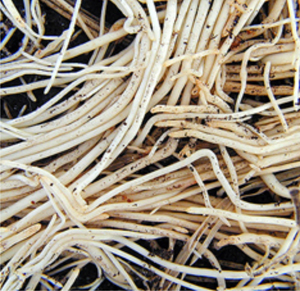 Figure viii. Healthy roots are typically white without whatever discolorations.
Purchase just healthy looking plants with medium to dark green foliage (unless leaf is supposed to be a different color).
Avert plants with unnaturally spotted, yellow, or brown leaves. If the plant is unhealthy at the plant nursery, chances are that it will die soon afterward consumer purchase. Await for pests on the undersides of leaves. Remove the found from the pot and examine the root organisation. Salubrious roots generally are and should be visible along the outside of the soil ball and should have an earthy smell (Figure 8).
Any discolorations, generally brown or blackened roots, are signs of issues. Some plants, such as Dracaenas, have roots with colors other than white. Unhealthy roots as well may aroma foul. If shopping for ferns, practice not be alarmed if you lot see brown-colored spots or long rows of structures on the lower foliage surface; these "spots" are reproductive structures called spores.
Selecting Containers
Planters can heighten the decorative value of the plants. Consider the following when selecting a planter:
- Suitability for the plant's needs
- Suitability for the needs of the individual and the environs
- Cost and availability
- Strength and durability
- Drainage
- Weight
The style, shape, and size of the container should complement the plants grown. Small-scale containers are best for minor slow-growing plants, while fast-growing plants are ameliorate suited for large containers.
Containers can exist made from a wide range of materials — terra cotta, clay, plastic, or ceramic. Terra cotta pots, fabricated of fired clay, are some of the most popular choices, with designs ranging from plainly to ornate. Plants perform very well in terracotta pots, every bit the porous surface allows expert air substitution between the institute roots and the environs. Other dirt containers (non considered terracotta) range from gray to brown in color, depending on the clay used. Dirt pots can be glazed or unglazed. The glazed pots restrict air commutation but offer more pattern choices. Unglazed pots evaporate water faster and plants in them may need more frequent watering. Disadvantages of dirt containers include their weight (specially large pots) and the adventure they will chip or break.
Constructed of materials such as polyethylene, polyurethane, recycled plastic, and fiberglass, plastic pots take evolved from very uncomplicated to quite elaborate. They have the advantage of beingness lightweight as well as flake- and pause-resistant. Air substitution and water evaporation rates are generally lower in plastic containers compared with dirt containers. Plants in plastic pots volition not dry out as rapidly as plants in clay pots, increasing the danger of over-watering.
In full general, there are ii types of containers — ones with drainage holes and ones without. Practice not allow plants in containers with drainage holes to sit in saucers filled with water, unless the establish is suspended in a higher place the water level past a layer of rocks. To avert salt buildup, leach the soil once a month by applying a gallon of water to every cubic pes of potting medium; after a few hours, follow with ½ gallon of water. If the potting medium contains garden soil, apply 5 gallons of h2o per every cubic foot of growing medium.
Containers without drainage holes work well for plants such as the Peace Lily (Spathiphyllum), which needs enough of water, but they should non be used for cacti and succulents.
Pruning, Preparation, Cleaning, and Repotting
When is the all-time time to prune? "When the knife is sharp" goes the old proverb, and information technology means using the natural life cycles equally a guide. For case, when the constitute is growing rapidly and you want to maintain a sure size, prune lightly and oftentimes, removing shoots or shoot tips when they are pocket-sized. When removing the very immature tips, the practise is known as pinching. Pinching and low-cal pruning also increase branching of the stem and result in a stockier, fuller establish.
When the plant has outgrown its container, root pruning is advisable. Pull roots away from the root mass then cut them dorsum to within 1 inch of the soil mass. An alternative method is to make iii or four vertical cuts 1 inch deep in the soil brawl on the opposite sides of the root ball.
If you are re-using containers, make sure that they are clean by washing out any quondam compost, chemical, or paint residues. Sterilize the container by placing it in a ten pct bleach solution and rinse well.
A make clean establish is a healthy constitute. H2o flow causes salt accumulation along the leaf margins and/or tips, creating necrotic areas. Dust dulls normal foliage coloration, lessening constitute value, but it besides shades plant surfaces, reflecting calorie-free that can be used in photosynthesis. Dust on lower foliage surfaces may clog stomata (specialized cells involved in water transpiration), inhibiting gas exchange within the leaf. Leaves with thick, shiny cuticles (Croton, Ficus, Peace Lily, Bromeliads) should be cleaned with a damp sponge.
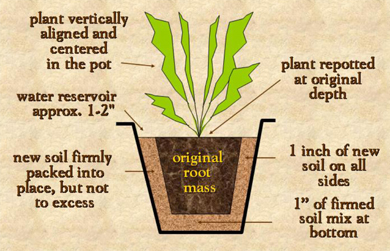 Figure ix. Properly repotted establish.
If the plant is small, dip the leaf in tepid water and swirl it around. H2o should not exist used when cleaning cacti, African violet leaves, and other plants with hairy leaves. Instead, utilise a clean, small paintbrush brush to remove dust. Remove dead flowers and leaves regularly. Leaves with tip and/or marginal necrosis, such as fluoride damage, should be trimmed to the salubrious part.
If the plant has been growing well, it will likely demand repotting. The decision to repot should be based on plant advent—if it is top-heavy, if it fills the container with new shoots, or if information technology has all-encompassing root growth out of the pot'south drainage holes. Ideally, plants should be repotted in i inch increments. Planting into too large a container volition give the roots more soil than they initially need. The excess soil will hold actress moisture, creating overly wet conditions. Increase pot size through smaller increments rather than doubling the pot size in one footstep (Figure nine).
Pest Management
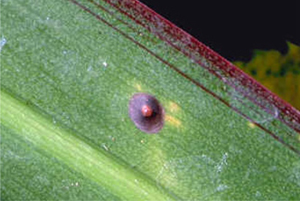 Figure ten. Diverse scales.
Very few plants stay pest-gratuitous forever. Pest insects are more likely to exist encountered on indoor plants than diseases because the interior environment rarely offers favorable weather condition for foliar diseases to develop. However, when plants are grown nether stressful conditions (such as low low-cal and excess h2o), soil-borne pathogens oftentimes develop.
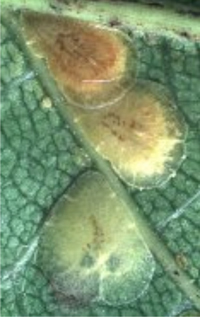 Figure 11. Various scales.
Scales are ⅛ inch to ⅓ inch long with various colors, depending upon the species. The three primary families of scales are armored (the torso covering can be separated from the body), soft (the body covering cannot exist separated from the body), and mealybugs. Scales suck found juices from leaves and stems, causing stunting, leaf discoloration, and expiry of the tissue. Equally a result of their feeding, gluey "honeydew" (digested plant sap) is excreted (the exception is armored scales). Honeydew offers a growing medium for a fungus called sooty mold, which, when nowadays, can detract from the found appearance and block light from reaching the leafage surface. Scales are commonly inconspicuous; by the fourth dimension infestation is noticed, the population is usually very large (Figure 10 and Figure 11).
Mealybugs are soft bodied, ane/five inch to 1/iii inch long, and covered by white, waxy filaments, giving them a white, cottony appearance. Insects are frequently constitute on the new growth at the stem apex, where they suck plant juices, causing leaf wilting and abscission (Figure 12). Some species of mealybugs appear first on the undersides of leaves. Mealybugs excrete sticky honeydew, which attracts sooty mold.
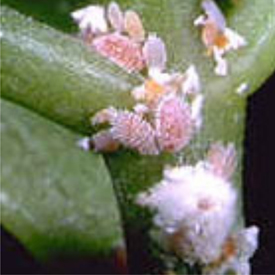 Figure 12. Mealybugs are the major pest problem for houseplants.
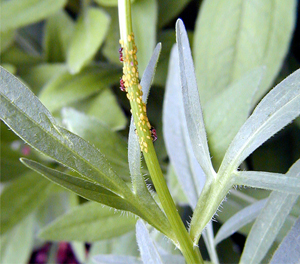 Figure 13. Aphids.
Aphids are soft bodied, pear shaped, one/25 inch to 1/eight inch long, and are commonly greenish in colour (just may be pink, blueish, brown, yellow, or black). Aphids reside on new growth or on the underside of young leaves, where they suck establish juices, causing deformed, curled growth of new leaves, buds, and flowers. Aphids as well excrete honeydew. Aphids are normally wingless only develop winged forms when colonies go likewise big (Figure 13).
Spider mites are the second most common pest problem on houseplants (Figure 14). The adult females are about 1/50 inch long, hardly visible with the unaided middle. Mites feed on the undersides of young leaves. Infected areas are grayish or yellow speckled.
Webs course as a means of dispersal. Spider mites thrive in hot and dry conditions.
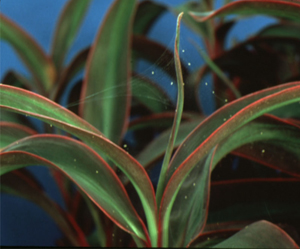 Figure 14. Spider mites with webbing.
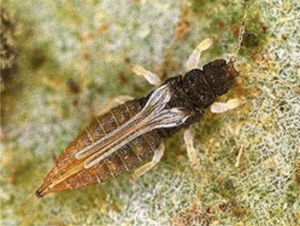 Effigy xv. Thrips.
Thrips, while uncommon on houseplants, predominantly feed on plants in patios and other outdoor areas (Figure 15). Thrips are small, slender, 1/25 inch to ane/12 inch long, and tan, blackness, or brownish in color, with lighter markings. Adults and larvae feed on shoot tips, flowers, and leaves by sucking sap and prison cell contents. Injured tissue has a whitish or silver-flecked appearance due to the lite reflecting from the empty cell walls of the dead cells.
What to Exercise for Found Problems
Pests
- The all-time method is prevention — purchase pest-gratis plants.
- Remove a light infestation of mealybugs or aphids with a cotton swab dipped in rubbing alcohol.
- If outdoor conditions permit, take the affected houseplant outside in a protected area, where natural predators will eventually come and rid the establish of the pest.
- Treat with insecticidal soap. The best results occur on plants that take been hardened off in the interior environment. New plants, if they have not been acclimatized (accustomed to lower light, fertilizer, and water levels), are going to be tender and should be treated subsequently the first couple of weeks. Add 2 teaspoons of insecticidal lather per gallon of water and wipe foliage and stems with the soapy water and soft fabric.
- Heavy infestations may be as well extensive to care for. Discard these plants and do not place them in your compost pile.
- Practise not introduce beneficial insects indoors! They may work neat in the greenhouse with a large number of plants and pests, but at that place is just not enough food in your home to sustain their population. Almost pests tin can be controlled culturally on indoor plants without the utilize of chemicals.
Another potential problem in the indoor garden is the occurrence of various diseases. For a disease to happen, three factors must exist nowadays: (ane) a susceptible constitute, (ii) a viable pathogen, and (3) a favorable environment. Because the habitation has very depression relative humidity and water is frequently applied directly to the growing medium (thus keeping the foliage dry), chances of a foliar disease occurring are minimal.
Leafage spots are the most common trouble, but they are ordinarily not acquired by a affliction. For example, leaf scalds occur when h2o droplets on the leaves human activity as lenses and focus excessive light in one spot, bleaching the chlorophyll and killing the underlying tissue. Spots with patterns are signs of a disease, including a tan eye, dark borders, and/or light-colored borders called "halos." Dark structures may be present on the underside; these incorporate a ways of dispersal called spores.
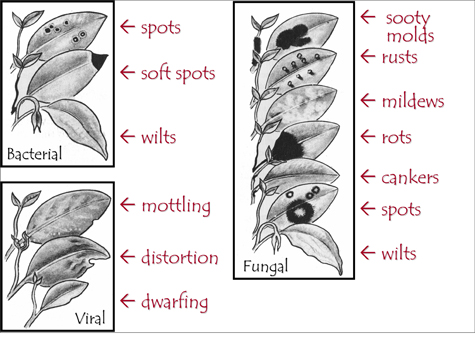 Figure 16. Bacterial diseases cause spots, soft spots, and wilts. The signs of a fungal illness are sooty molds, rusts, mildews, rots, cankers, spots, and wilts. Viral diseases cause mottling, distortion, and dwarfing.
Most importantly, avoid causing stress to plants. A good for you found is much more likely to fight off a disease than a stressed ane. Use a simplified key for identifying the causal agent for a affliction (Figure sixteen).
Soil-borne pathogens are commonly constitute on stressed plants. Soil-borne pathogens affect plants at or below the soil line; affliction development is ordinarily well underway before symptoms are noted on plant parts aboveground. Soil-borne diseases usually occur when the growing medium is kept excessively moist and fertility levels are loftier. Low low-cal and over-watering create favorable environments for soil-borne diseases indoors.
The most common causes of stress in interiors are low light and over-watering.
Summary of Cultural Care
Table 3 provides a listing of more than than 200 plants and their cultural requirements. To summarize cultural care guidelines, the following abbreviations and coding numbers are used. These guidelines use to actively growing indoor plants.
L = Light
- Sunny light areas: At least four hours of direct lord's day
- Loftier-lite areas: Over 200 ft-c, simply not direct dominicus
- Medium-light areas: 75 ft-c to 200 ft-c
- Low-low-cal areas: 25 ft-c to 75 ft-c
T = Temperature
- Absurd: fifty°F night, 65°F day temperatures
- Boilerplate: 65°F night, 75°F day temperatures
- Warm: 70°F night, 85°F mean solar day temperatures
H = Relative Humidity
- High: 50% or higher
- Average: 25% to 49%
- Low: 5% to 24%
Due west = Watering
- Continue soil mix moist
- Surface of soil mix should dry earlier re-watering
- Soil mix can go moderately dry before re-watering
S = Suggested Soil Mix
For specific ingredients, refer to the various growing mixes in "Soil/Growing Medium." The soil mixes are keyed as follows:
- Flowering house plants
- Foliage plants
- Bromeliads
- Orchids
- Succulents and cacti
- Ferns
- African violets and other Gesneriads
| Table 3. Indoor plants and their cultural requirements (adopted from McConnell, D. B. 1978) | ||||||
| Botanical Name | Common Name | Cultural Intendance | ||||
| L | T | H | W | Due south | ||
| Abutilon hybridum | Flowering Maple | i | 1 | 2 | ii | 1 |
| Acalypha hispida | Chenile Plant | i | 2 | two | 2 | ane |
| Achimenes hybrids | Magic Flower | two | 2 | 2 | ane | 7 |
| Acorus calamus | Sweet Flag | 2-3 | ii | 2 | one | 2 |
| Acorus gramineus | Miniature Sugariness Flag | 2-3 | 2 | 2 | 1 | ii |
| Adiantum raddianum | Maidenhair Fern | 2-3 | 2 | 1 | 1 | 6 |
| Adromischus cristatus | Crinkle-Leaf Plant | ii-iii | two | ii | two | 5 |
| Adromischus festivus | Plover Eggs | 2-3 | 2 | ii | ii | 5 |
| Aechmea fasciata | Silver Vase | 2-3 | 2 | 2 | ii | 3 |
| Aechmea miniata 'Discolor' | Purplish Coral Drupe | two-3 | two | two | ii | 3 |
| Aechmea 'Purple Wine' | Purple Wine Bromeliad | 2-3 | 2 | ii | 1 | 3 |
| Aeschynanthus marmoratus | Zebra Handbasket Vine | 2 | 2 | 2 | one | 7 |
| Aeschynanthus pulcher | Lipstick Vine | 2 | ii | 2 | 1 | 7 |
| Agave Americana 'Marginata' | Variegated Century Plant | one | 2 | 3 | 3 | five |
| Agave victoriae-reginae | Queen Agave | 1 | 2 | 2 | 2 | 5 |
| Aglaonema modestum | Chinese Evergreen | iii-iv | ii | 2 | ii | two |
| Aglaonema 'Silver King' | Argent Male monarch | 3-four | 2 | two | 2 | 2 |
| Aglaonema 'Silver Queen' | Silver Queen | 3-iv | ii | 2 | 2 | 2 |
| Allamanda cathartica | Allamanda | 1 | 2 | i-two | 2 | i |
| Alloplectus nummularia | Miniature Pouch Flower | two-3 | ii | i-2 | 1 | seven |
| Aloe aborescens | Candelabra Establish | 1 | 3 | iii | 3 | v |
| Aloe barbadensis | Medicine Plant | 1 | 3 | 3 | iii | five |
| Aloe brevifolia | Brevifolia Aloe | 1 | 3 | iii | 3 | 5 |
| Ananas comosus | Pineapple | 1-2 | 2 | 2 | 1 | three |
| Anthurium clarinervium | Dwarf Crystal Anthurium | ii-3 | 2 | one-two | i | 2 |
| Anthurium hookeri | Bird's Nest Anthurium | two-three | 2 | 1-two | 1 | 2 |
| Anthurium scherzeranum | Flamingo Blossom | 2-3 | two | 1-2 | 1 | 6 |
| Aphelandra squarrosa | Zebra Establish | 2 | 2 | 2 | 1 | two |
| Araucaria heterophylla | Norfolk Island Pine | 2-iii | ii | ii | 1 | 2 |
| Ardissa crenata | Ardisia | 2-3 | 2 | 2 | 1 | ii |
| Asparagus densiflorus 'Myers' | Plume Asparagus | 2-3 | 2 | 2 | ii | 2 |
| A sparagus densiflorus 'Sprengeri' | Foxtail Fern | 2-3 | 2 | 2 | 2 | two |
| Asparagus falcatus | Sickle Thorn | 2-three | ii | 2 | 2 | 2 |
| Aspidistra elatior | Cast Iron Plant | 3-4 | 2 | iii | 2 | 2 |
| Asplenium daucifolium | Mother Fern | 3 | two | 2 | one | six |
| Asokebuyn budys | Bird's Nest Fern | iii | 2 | ii | one | 6 |
| Astrophytum myriostigma | Bishop's Cap | ii | ii | 3 | 3 | 5 |
| Beaucarnea recurvata | Ponytail | ane | 2 | 3 | 3 | 5 |
| Begonia cubensis | Cuban Holly | 2-iii | 2 | 2 | two | two |
| Begonia metallica | Metal Leaf Begonia | 2-3 | 2 | two | 2 | 2 |
| Begonia x rex-cultorum | Rex Begonia | 2-3 | two | 2 | ii | 2 |
| Begonia semperflorens | Wax Begonia | 1-2 | i | 2 | 2 | i |
| Billbergia nutans | Queen's Tears | two-iii | 2 | 2 | 2 | iii |
| Billbergia pyramidalis | Urn Plant | 2-3 | 2 | 2 | 2 | 3 |
| Billbergia zebrina | Zebra Plant | 2-3 | 2 | ii | 2 | iii |
| Bougainvillea spp. | Bougainvillea | 1 | 2 | 3 | 3 | 1 |
| Brassaia actinophylla | Schefflera | 2-three | 2 | 2 | 2 | two |
| Brassaia arboricola | Dwarf Schefflera | 2-3 | 2 | 2 | 2 | 2 |
| Caladium spp. | Caladium | two | two | 1 | 1 | 2 |
| Calathea insignis | Rattlesnake Institute | 2-three | ii | 2 | 1 | two |
| Calathea makoyana | Peacock Establish | 2-iii | 2 | 2 | 1 | 2 |
| Calathea micans | Miniature Maranta | two-3 | 2 | ii | 1 | 2 |
| Calathea roseopicta | Rose Calathea | 2-3 | 2 | 2 | 1 | 2 |
| Calceolaria crenatiflora | Slipperwort | two | 1 | i | 1 | 1 |
| Callisia elegans | Striped Inch Plant | 2-3 | 2 | 2 | 2 | two |
| Carissa grandiflora 'Bonsai' | Bonsai Natal Plum | 1-2 | 2-3 | 2 | 2 | i |
| Carissa grandiflora 'Boxwood Beauty' | Boxwood Beauty | 1-2 | 2-3 | 2 | 2 | 1 |
| Caryota mitis | Fishtail Palm | 2-3 | 2 | ii | 2 | 2 |
| Catharanthus roseus | Madagascar Periwinkle | ane-ii | two | one-2 | ii | i |
| Cereus peruvianus | Peruvian Apple Cactus | 1 | ii-3 | 3 | 3 | v |
| Ceropegia woodii | Rosary Vine | 2-three | ii | 2 | 2 | 5 |
| Chamaedorea elegans | Parlor Palm | 3-4 | 2 | 2 | ii | two |
| Chamaedorea erumpens | Bamboo Palm | 3-four | 2 | two | 2 | two |
| Chamaerops humilis | European Fan Palm | 2-3 | 2 | ii | 2 | 2 |
| Chirita lavandulacea | Hindustan Gentian | ii-3 | 2 | 1-ii | 1 | seven |
| Chlorophytum comosum 'Variegatum' | Variegated Spider Plant | 2-three | two | two | ane | 2 |
| Chlorophytum comosum 'Vittatum' | Spider Institute | 2-3 | two | 2 | 1 | ii |
| Chrysalidocarpus lutescens | Areca Palm | 2-3 | 2 | 2 | 1 | ii |
| Chrysanthemum morifolium | Chrysanthemum | 1 | 2 | 2 | 1 | 1 |
| Cissus antarctica | Kangaroo Vine | ii-three | ii | 2 | 2 | 2 |
| Cissus rhombifolia | Grape Leaf Ivy | ii-3 | 2 | 2 | ii | 2 |
| Cissus rotundifolia | Wax Cissus | two | ii | 3 | iii | ii |
| Cissus striata | Miniature Grape Ivy | 2-3 | 2 | two | 2 | 2 |
| Citrofortunella mitis | Calamondin Orange | ane-2 | one | 2 | two | one |
| Clivia miniata 'Grandiflora' | Kafir Lily | 2 | 2 | 2 | 2 | 1 |
| Codiaeum variegatum | Croton | ane | two | 1 | 1 | 2 |
| Coffeaa arabica | Coffee | 2 | ii | two | two | 1 |
| Coleus blumeri | Coleus | two-iii | two | two | 2 | one |
| Colummea hybrids | Goldfish Found | 2-3 | two | 1-2 | ane | vii |
| Cordyline terminalis | Ti Plant | 2 | 1-ii | 2 | ii | 2 |
| Crassula argentea | Jade Plant | 2-3 | 2 | 2 | two | two |
| Crassula falcata | Propeller Plant | one-2 | 2 | 2 | 3 | 5 |
| Crassula hemisphaerica | Arab's Turban | i-two | 2 | 2 | 3 | 5 |
| Crassula lycopodioides | Toy Cypress | ane-ii | 2 | ii | two | v |
| Crassula schmidtii | Cerise Flowering Crassula | 2-3 | 2 | 2 | ii | 5 |
| Crassula teres | Rattlesnake Tail | 2-iii | 2 | 3 | 3 | 5 |
| Crossandra infundibuliformis | Crossandra | 2 | ii | 2 | 1 | 1 |
| Cryptanthus bivittatus 'Minor' | Dwarf Rose Stripe Star | ii | ii | two | 2 | 3 |
| Cryptanthus fosteranus | Potent Pheasant Leaf | 2 | 2 | 2 | 2 | three |
| Cryptanthus zonatus | Zebra Establish | 2 | 2 | 2 | 2 | 3 |
| Cyrtomium falcatum 'Rochfordianum' | House Holly Fern | 2-iii | two | 2 | two | 6 |
| Davallia fejeensis | Rabbit'southward Pes Fern | 2-3 | two | i | 1 | three |
| Dieffenbachia 'Exotica Perfection' | Exotica Perfection | 2-3 | two | 2 | 2 | two |
| Dieffenbachia maculata | Spotted Dumb Cane | 3 | 2 | 2 | ii | two |
| Dizygotheca elegantissima | False Aralia | 2-three | 2 | ii | 2 | 2 |
| Dracaena deremensis 'Janet Craig' | Janet Craig | ii-iv | 2 | 2 | ii | 2 |
| Dracaena deremensis 'Warneckii' | Warneckii | 2-iv | 2 | 2 | 2 | 2 |
| Dracaena fragrans 'Massangeana' | Corn Plant | two-3 | 2 | two | 2 | ii |
| Dracaena marginata | Marginata | 2-4 | 2 | ii | 2 | two |
| Dracaena surculosa | Gilded Grit Dracaena | 2-four | 2 | 2 | 2 | ii |
| Dyckia brevifolia | Miniature Agave | i-ii | 2 | 3 | 2-iii | ii |
| Dyckia fosterana | Silver and Gilt Dyckia | 1-2 | two | 3 | two-3 | 3 |
| Echeveria agavoides | Molded Wax | 1-ii | 2 | 3 | iii | 5 |
| Echeveria elegans | Mexican Snowball | one-2 | 2 | 3 | three | 5 |
| Echinocereus reichenbachii | Lace Cactus | 1-2 | 2 | 3 | iii | 5 |
| Epidendrum atropurpureum | Spice Orchid | ii | 2 | i-2 | ane | 4 |
| Epiphyllum hybrids | Orchid Cacti | 2 | 2 | 2 | 2 | 1 |
| Epipremnum aureum | Gold Pothos | ii-4 | 2 | two | 2 | 2 |
| Epipremnum aureum 'Marble Queen' | Marble Queen | ii-4 | 2 | 2 | 2 | two |
| Episcia cupreata | Flame Violet | 2 | ii-iii | 1 | 1 | vii |
| Episcia dianthiflora | Lace-Bloom Vine | ii | 2-three | 1 | 1 | 7 |
| Episcia reptans | Scarlet Violet | 2 | two-3 | one | 1 | 7 |
| Euphorbia coeralescens | Blue Euphorbia | two-three | 2 | ii-three | 2-3 | 5 |
| Euphorbia mammillaris | Corncob Cactus | 1 | ii | 2-3 | iii | 5 |
| Euphorbia milii splendens | Crown-of-Thorns | one | ii | 2-three | 3 | 5 |
| Euphorbia pulcherrima | Poinsettia | 1-2 | 2 | ii | 2 | one |
| Euphorbia tirucalli | Milkbush | 1-2 | ii | ii | 2 | 1 |
| Fatshedera lizei | Botanical Wonder Plant | two-3 | 1-two | ii | 2 | 2 |
| Fatsia japonica | Japanese Aralia | iii-4 | ane-2 | 2 | 2 | ii |
| Ficus benjamina | Weeping Fig | 1-3 | 2 | 2 | 2 | 2 |
| Ficus deltoidea | Mistletoe Ficus | two-3 | 2 | 2 | 2 | two |
| Ficus elastica 'Decora' | Rubber Constitute | 1-3 | ii-3 | two | 2 | 2 |
| Ficus lyrata | Fiddle-Foliage Fig | i-3 | ii | 2 | 2 | 2 |
| Ficus pumila 'Minima' | Dwarf Creeping Fig | 2-3 | 2 | two | 2 | 2 |
| Ficus retusa | Cuban Laurel | 2-3 | 2 | 2 | two | 2 |
| Ficus sagittata | Rooting Fig | 2-3 | 2 | two | 2 | 2 |
| Ficus willdemaniana | Dwarf Fiddle-Foliage Fig | ii-iii | ii | 2 | two | 2 |
| Fittonia verschaffeltii | Ruddy-Nerved Fittonia | 2-iii | ii | 1 | 1 | 2 |
| Fittonia verschaffeltii argyroneura | Silver-Nerved Fittonia | two-3 | 2 | i | ane | 2 |
| Fuchsia hybrida | Fuchsias | 2 | ane-ii | ane | 1 | 1 |
| Gasteria hybrida | Ox Tongue | 2 | ii | 2 | 3 | 5 |
| Graptopetalum amethystinum | Jewel Leaf Constitute | two-three | 2 | 2-3 | 3 | five |
| Guzmania lingulata 'Major' | Ruby Star | 2 | ii | ane | 2 | 3 |
| Guzmania monostachia | Striped Torch | 2 | two | 1 | 2 | 3 |
| Gynura aurantiaca 'Purple Passion' | Purple Passion | two-3 | 2 | two | 2 | two |
| Haworthia cuspidata | Star Window Plant | 1-two | 2 | three | 2-3 | 5 |
| Haworthia fasciata | Zebra Haworthia | ane-2 | 2 | iii | two-3 | 5 |
| Haworthia subfasciata | Little Zebra Plant | ii | 2 | 3 | ii-3 | 5 |
| Haworthia truncata | Clipped Window Plant | 1-2 | 2 | three | 3 | 5 |
| Hedera canariensis | Algerian Ivy | ii-3 | 1-2 | 2 | two | 1 |
| Hedera helix | English Ivy | 2-three | one-2 | 2 | ii | 1 |
| Hemigraphis alternata | Waffle Plant | ii-iii | 2 | 2 | 2 | 2 |
| Hibiscus rosa-sinensis | Chinese Hibiscus | ane | 2 | two | ii | 1 |
| Hippeastrum hybrids | Amaryllis | 2 | 2 | 2 | 2 | one |
| Howea belmoreana | Belmore Sentry Palm | 3-ii | 2 | 2 | two | 2 |
| Howea forsterana | Kentia Palm | 2-4 | 2 | two | 2 | two |
| Hoya carnosa 'Variegata' | Wax Establish | 2-3 | 2 | 2-3 | 2 | 2 |
| Hoya kerrii | Sweetheart Hoya | 2 | 2 | two | 2 | 2 |
| Hyacinthus orientalis | Hyacinth | 2 | i-2 | 2 | 1 | i |
| Impatiens wallerana 'Variegata' | Decorated Lizzie Impatiens | 2-3 | 2 | 2 | 2 | i |
| Ixora coccinea | Ixora | one | 2 | 2 | ii | 1 |
| Jatropha integerrima | Peregrian | i | 2 | 2 | ii | 1 |
| Justicia brandegeana | Shrimp Constitute | one-2 | two | 2 | 2 | i |
| Kalanchoe blossfeldiana | Christmas Kalanchoe | 1-ii | 2 | 2 | 2 | i |
| Kalanchoe pumila | Dwarf Majestic Kalanchoe | ane-two | ii | 2-3 | 3 | 5 |
| Kalanchoe tomentosa | Panda Plant | 1-2 | 2 | 2-3 | 3 | v |
| Malvaviscus arboreus | Turk'south Cap | 1 | 2 | ii | one | 1 |
| Mammillaria bocasana | Pulverization Puff | 1-two | 2 | 3 | 3 | 5 |
| Manettia inflata | Firecracker Plant | 2 | 2 | 1-ii | two | 1 |
| Maranta leuconeura erythroneura | Scarlet Nerve Establish | 2-3 | 2 | 2 | 2 | two |
| Maranta leuconeura kerchoviana | Prayer Plant | two-3 | 2 | 2 | two | 2 |
| Mikania ternata | Plush Vine | 2-3 | 2 | 2 | 2 | 2 |
| Monstera deliciosa | Philodendron Pertusum | two-4 | 2 | 2 | 2 | two |
| Monstera obliqua | Window Foliage | 3 | 2 | 2 | 2 | 2 |
| Nautilocalyx lynchii | Black Alloplectus | 2-3 | 2 | ii | 1 | vii |
| Neoregelia carolinae 'Tricolor' | Tricolor Bromeliad | 2-3 | ii | 2 | 2 | 3 |
| Neoregelia spectabilis | Fingernail Establish | ii-three | 2 | 2 | 2 | 3 |
| Neoregelia zonata | Zonata | 2-iii | 2 | two | ii | 3 |
| Nephrolepis exaltata 'Bostoniensis' | Boston Fern | 2-three | 2 | 1-2 | 2 | half dozen |
| Nephrolepis exaltata 'Fluffy Ruffles' | Fluffy Ruffles | 2-3 | two | 1 | 2 | 6 |
| Nidularium innocentii nana | Miniature Bird'due south Nest | 2-3 | 2 | two | 1 | three |
| Opuntia vilis | Little Tree Cactus | ane-ii | two | 3 | iii | 5 |
| Opuntia vulgaris | Irish Mittens | 1-2 | ii | 3 | 3 | 5 |
| Oxalis flava | Finger Oxalis | 1-2 | 2 | ii | 2 | 1 |
| Oxalis rubra | Red Oxalis | 1-2 | 2 | 2 | 2 | ane |
| Pachyphytum oviferum | Pearly Moonstones | 1-2 | 2 | two-iii | two-iii | 5 |
| Pachystachys lutea | Yellow Shrimp Constitute | 2-3 | 2 | 2 | 2 | 1 |
| Paphiopedilum hybrids | Ladyslipper Orchids | 2-3 | 2 | ii | one-2 | 4 |
| Pedilanthus tithymaloides 'Variegatus' | Devil'southward Backbone | 2-3 | 2 | 2 | 2 | 5 |
| Pelargonium hortorum | Firm Geranium | ane-2 | 1-two | 2-3 | 2 | 1 |
| Pelargoniium peltatum | Ivy Geranium | 1-ii | 1-2 | 2 | 2 | ane |
| P ellaea rotundifolia | Button Fern | 2-iii | ii | 2 | 1-2 | half dozen |
| P ellionia pulchra | Satin Pellionia | ii-3 | 2 | 2 | 1-2 | 2 |
| P entas lanceolata | Egyptian Star Cluster | 1 | 2 | 2 | 2 | 1 |
| P eperomia caperata | Emerald Ripple | 2-3 | 2 | 2 | 2 | 2 |
| P eperomia crassifolia | Leather Peperomia | 2-3 | two | two | 2 | 2 |
| P eperomia obtusifolia | Infant Rubber Tree | 2-three | 2 | ii | two | ii |
| P hilodendron bipennifolium | Fiddle-Leafage Philodendron | 3-4 | ii | 2 | ii | 2 |
| P hilodendron 'Emerald Queen' | Emerald Queen | 2-4 | 2 | 2 | 2 | 2 |
| P hilodendron 'Florida' | Florida | two-four | ii | 2 | two | two |
| Philodendron scandens oxycardium | Eye-Leafage Philodendron | ii-4 | 2 | 2 | 2 | 2 |
| Philodendron selloum | Selloum | 2-4 | ii | 2 | 2 | ii |
| Phoenix roebelenii | Pigmy Date Palm | ii-3 | two | 2 | 2 | 2 |
| Pilea cadierei | Aluminum Plant | ii-iii | ii | 1-2 | i | 2 |
| Pilea microphylla | Arms Plant | 2-iii | 2 | 1 | 1 | 2 |
| Platycerium bifurcatum | Staghorn Fern | 2-3 | 2 | two | 2 | vi |
| Plectranthus australis | Swedish Ivy | 2-3 | 2 | 2 | two | 2 |
| Plectranthus australis | Candle Plant | 2-iii | 2 | 2 | two | two |
| Podocarpus macrophyllus | Podocarpus | ii-3 | two | 2 | 2 | two |
| Polyscias balfouriana 'Marginata' | Variegated Balfour Aralia | 2-3 | two | 2 | 2 | 2 |
| Polyscias fruticosa | Ming Aralia | two-3 | 2 | ii | 2 | 2 |
| Rhapis excelsa | Lady Palm | 2-3 | 2 | 2 | 2 | two |
| Rhododendron hybrids | Azaleas | 2 | ane-2 | 1 | ane | ii |
| Ruellia graeciznas | Cherry-red-Spray Ruellia | 1-2 | 2 | ii | 2 | ane |
| Saintpaulia hybrids | African Violets | 2-3 | 2 | 2 | i | 7 |
| Sansevieria parva | Parva Sansevieria | ii-three | two | 3 | 2-3 | 5 |
| Sansevieria trifasciata 'Hahnii' | Birdsnest Sansevieria | 2-four | 2 | 3 | 2-3 | 5 |
| Sansevieria trifasciata 'Laurentii' | Gold-Banded Sansevieria | two-4 | 2 | 3 | 2-three | v |
| Saxifraga stolonifera | Strawberry Geranium | 2-3 | 1-ii | 2 | two | ii |
| Schlumbergera bridgesii | Christmas Cactus | 2-3 | 2 | 2 | 2 | ii |
| Schlumbergera truncata | Christmas Cactus | 2-3 | 2 | 2 | 2 | 2 |
| Scindapsus pictus | Argent Pothos | 3 | ii | 2 | 2 | 2 |
| Sedum spectabile | Showy Sedum | 1-2 | i-2 | 2-iii | ii-iii | 5 |
| Sempervivum arachniodeum | Cow Spider web Houseleek | ane-2 | ane-2 | 2-3 | 2-iii | five |
| Setcreasea pallida 'Regal Center' | Purple Center | 1-2 | ii | 2 | ii | 2 |
| Sinningia speciosa | Gloxinia | 2-3 | ii | 1-2 | 2 | seven |
| Soleirolia soleirolii | Baby Tears | ii-three | ii | 1-ii | ane | 2 |
| Spathiphyllum 'Clevelandii' | Peace Lily | two-3 | ii | two | i | ii |
| Spathiphyllum 'Mauna Loa' | Mauna Loa | 2-three | 2 | 2 | 1 | ii |
| Stapelia nobilis | Carrion Blossom | 1-2 | 2 | 2-3 | two-iii | 5 |
| Streptocarpus ten hybridus | Cape Primrose | two-3 | two | 2 | two | seven |
| Strobilanthes dyeranum | Persian Shield | 2-iii | ii | 2 | 2 | 2 |
| Syngonium podophyllum | Nephthytis | 2-iv | ii | 2 | 2 | 2 |
| Trillandsia bulbosa | Dancing Bulb | 2 | 2 | 2 | ii | 3 |
| Tillandsia lindenii | Blueish-Flowered Torch | 2 | 2 | 2 | 2 | 3 |
| Tolmiea menziesii | Piggyback Plant | two | 1-2 | two | 2 | ii |
| Tradescantia blossfeldiana | Flowering Inch Plant | 2-three | ii | two | 2 | 2 |
| Tradescantia sillamontana | White Velvet | two-three | 2 | 2 | 2 | 2 |
| Vriesea splendens | Flaming Sword | 2 | 2 | 2 | 2 | 3 |
| Yucca elephantipes | Spineless Yucca | 2 | 2 | 3 | ii | 2 |
| Zebrina pendula | Wandering Jew | two-3 | ii | 2 | two | 2 |
Bibliography
Manaker, G. H. (1997). Interior plantscapes: Installation, maintenance, and direction (tertiary ed.). Prentice Hall.
McConnell, D. B. (1978). The indoor gardener'due south companion: A definitive, color-illustrated guide to the selection and intendance of houseplants. Van Nostrand Reinhold Company.
Condition and Revision History
Published on Dec xv, 2006
Published on October xiii, 2009
Published with Full Review on Dec 01, 2012
Published with Total Review on Jan 05, 2017
Published with Total Review on May 27, 2020
Published with Full Review on Jul 21, 2022

How Many Degrees It Is,
Source: https://extension.uga.edu/publications/detail.html?number=B1318
Posted by: howardwalathever68.blogspot.com
0 Response to "How Many Degrees It Is"
Post a Comment